7 July 2011

Need a sound module for your embedded project that can drive a speaker directly, has bucket loads of memory, and can play back audio samples on command? Do we have a product for you! After much hunting and haggling and designing and testing, we present the MOD-1007 SoundOut audio module.
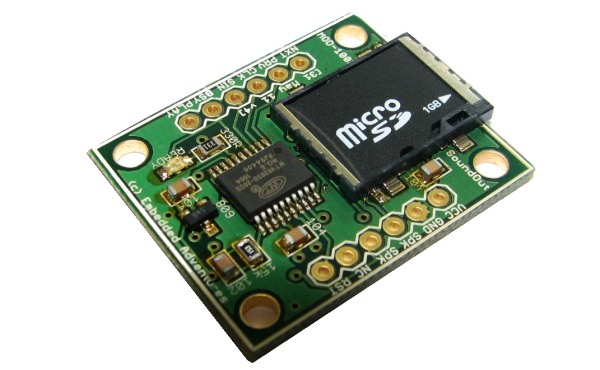


MOD-1007 SoundOut Audio Module


Compatible with the SOMO-14D module (at least, it uses the same playback chip - the pinout is slightly different), this module allows you to start sample playback using press buttons or using a synchronous (clocked) serial connection to your microcontroller, using an easy protocol. Of course, the PicPack library already has sample code available if you need a hand.  The module plays back .AD4 files, which can be created from .MP3 or .WAV files using a utility provided.

13 June 2011

Power up!

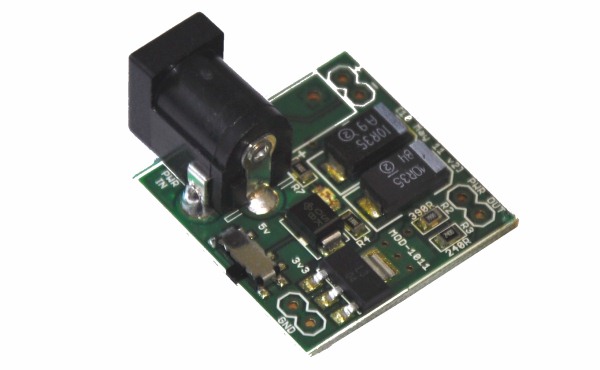
Need 3.3V or 5V for your breadboard experiment or next project? The MOD-1011 is just for you! Throw up to 30V at it and it'll give you a nice, regulated supply at up to 1A - we've used low ESR tantalum capacitors to ensure superior regulation to what you normally get with your average breadboard power supply.


MOD-1011 Power Supply Module

10 June 2010

New web site


Please pop over to our shiny new web site at
Looking forward to seeing you soon!

2 December 2009

SOMO-14D audio module


The Somo 14D is a cute little module from 4D - plays audio files you put on a micro SD card. Aside from some difficulties with the brand of card you use, it kind of worked... but wouldn't play the files I requested.

Now, bring in the Logic tool. Honestly, I can't believe I didn't buy this or something like this years ago.

Turns out this module is very particular also about the timing of commands you send it. The clock pulses have to be 200us. And that's exactly what I had in my code:


void somo_14d_send_data(uns16 data) {

// Signal start
clear_pin(somo_14d_clk_port, somo_14d_clk_pin);
delay_ms(2); // tSTART = 2ms

for (uns8 count = 0; count < 16; count++) {
if (data.15) {
set_pin(somo_14d_data_port, somo_14d_data_pin);
} else {
clear_pin(somo_14d_data_port, somo_14d_data_pin);
}
delay_us(1); // tDS = 1us
set_pin(somo_14d_clk_port, somo_14d_clk_pin);
delay_us(200); // tCH = 200us
clear_pin(somo_14d_clk_port, somo_14d_clk_pin);
delay_us(200); // tCL = 200us
data = data << 1;
}
// Signal end
set_pin(somo_14d_clk_port, somo_14d_clk_pin);
delay_ms(2); // tSTOP = 2ms
}


All looks perfectly okay, right?

Now look at what Logic says. The pulse is actually about 100us. Half the...hang on. In my config.h I had the clock rate of the chip at 20Mhz when in fact it's running at 40Mhz. Ha! Once again, Logic to the rescue.

29 October 2009

Smashing Pumpkins


Combine hobby electronics, photography and fruit and vegetables dropped from a second floor balcony, what do you get?

My brother does fun stuff with cameras for a living - see www.seesawphoto.com.au - but we decided to combine his photography skills and equipment and some gear from Sparkfun and the PicPack library to see if we couldn't smash a few things up.


What could be more fun than smashing eggs, watermelons and pumpkins all in the name of a good photo?


The trick of course is to capture the image just at the right moment. We rigged up a microphone to a Pic demo board (which rather nicely has buttons, an LCD display, and a relay to trigger the flash. We grabbed a wired connection to a camera-mounted flash - wired that to the relay output from the board and then used that to trigger Paul's top knotch professional studio flash gear. The microphone was wired to the analogue input and sampled as quickly as the Pic could manage it.


Knocking together the Pic application didn't take long with the library functions. The buttons allowed a configurable delay in milliseconds between hearing sound and triggering the flash, and sound sensitivity. Of course some experimentation was required here - more things to smash! In the end we built an audible delay in so that we had a chance to "arm" the system, then get out of the way before the pumpkins came down.


I think you'll agree the photos are pretty fun. Source code will be published in the next drop of PicPack.